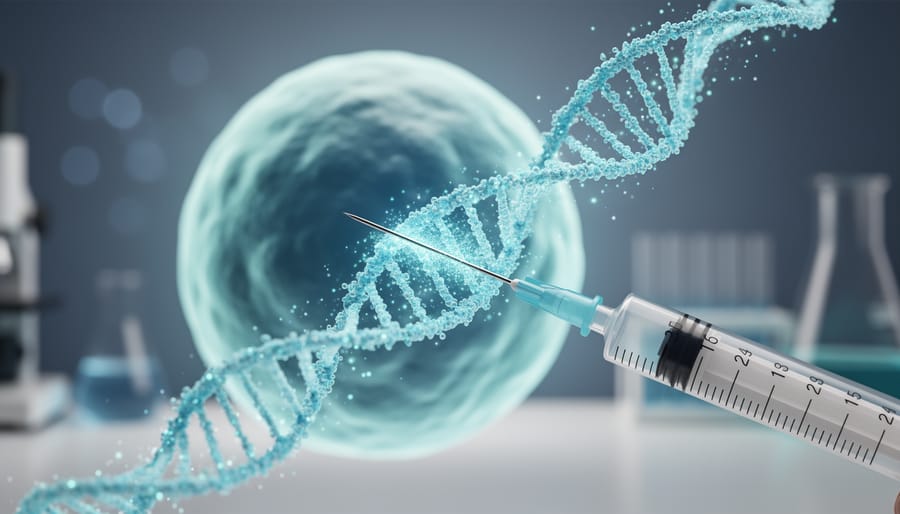
What Is Molecular Diagnostics (and How Does It Work)?

What Is Molecular Diagnostics (and How Does It Work)?

Molecular diagnostics is the detection and analysis of biological markers in the genome and proteome using molecular biology techniques to diagnose disease, assess risk, guide treatment decisions, and monitor therapeutic response. Unlike traditional diagnostic methods that identify phenotypic changes or culture pathogens over days, molecular diagnostics detects the genetic and molecular signatures of disease at the nucleic acid or protein level, often within hours.
This field has transformed clinical medicine by enabling precision diagnostics that were impossible a generation ago. When a clinician needs to identify a pathogen in a …

Read More
What Is X-Ray Artificial Intelligence (and How Does It Work)?

What Is X-Ray Artificial Intelligence (and How Does It Work)?

X-ray artificial intelligence refers to machine learning systems trained to interpret X-ray crystallography data, automate structural analysis, and predict molecular configurations with unprecedented speed and accuracy. These AI models are transforming how researchers solve protein structures, accelerate drug discovery, and analyze complex biomolecular interactions that were once prohibitively time-consuming to decode manually.
The convergence of X-ray diffraction techniques and deep learning represents one of the most significant advances in structural biology since the invention of synchrotron radiation sources. Traditional X-ray …

Read More
What Is the Trends in Molecular Medicine Impact Factor (and Why Does It Matter)?

What Is the Trends in Molecular Medicine Impact Factor (and Why Does It Matter)?

The Impact Factor for Trends in Molecular Medicine stands at 18.1 for 2026, placing the journal at rank 8 out of 328 publications in the molecular biology category and securing a Q1 (first quartile) designation. This metric quantifies how frequently articles published in the journal are cited by other researchers, calculated by dividing the number of citations in the current year by the total number of citable articles published in the preceding two years.
For molecular biologists, clinicians, and research administrators evaluating publication venues or assessing scholarly contributions, understanding these numbers matters beyond …

Read More
How Artificial Intelligence and Data Science Are Transforming Modern Molecular Biology

How Artificial Intelligence and Data Science Are Transforming Modern Molecular Biology

Artificial intelligence and data science have fundamentally transformed molecular biology research by enabling scientists to extract meaningful patterns from massive genomic datasets, predict protein structures with unprecedented accuracy, and accelerate drug discovery timelines from years to months. These computational disciplines now serve as essential tools in modern laboratories, where researchers apply machine learning algorithms to interpret complex biological systems, automate experimental workflows, and identify therapeutic targets that would remain hidden in traditional analysis approaches.
The integration of AI-driven …

Read More
What Are Impact Factor Trends in Cell Biology (and How Do They Shape Research)?

What Are Impact Factor Trends in Cell Biology (and How Do They Shape Research)?

Impact factor trends in cell biology refer to the shifting patterns in journal citation metrics that measure how frequently articles from specific cell biology publications are cited within the scientific literature. These metrics, primarily calculated as the average number of citations per article over a two-year period, have become increasingly complex as new alternatives and complementary measures emerge to evaluate research influence.
The landscape of academic publishing in cell biology has transformed substantially. Traditional impact factors, once the dominant measure of journal prestige, now compete with article-level metrics…

Read More
THCP Biosynthesis Reveals Why This Cannabinoid Is 33x More Potent Than THC

THCP Biosynthesis Reveals Why This Cannabinoid Is 33x More Potent Than THC

Budpop’s THCP represents a breakthrough in cannabinoid molecular biology research, challenging established paradigms about phytocannabinoid potency and receptor selectivity. Tetrahydrocannabiphorol (THCP), first isolated in 2019, exhibits a binding affinity for CB1 receptors 33-fold higher than Δ9-tetrahydrocannabinol (THC), fundamentally altering our understanding of cannabis pharmacology and demanding rigorous investigation into its biosynthetic pathways and molecular mechanisms.
Understanding THCP biosynthesis begins with analyzing the enzymatic modifications that extend the alkyl …

Read More
Healthy Living – Is Mowing the Lawn Good Exercise?

Healthy Living – Is Mowing the Lawn Good Exercise?

Mowing is one hell of a task! And it does feel like you are lifting dumbells sometimes. But “Is mowing the lawn good exercise?” At first glance, pushing a lawn mower across a stretch of grass might not seem comparable to a session at the gym.
However, this seemingly mundane chore could offer more than a well-kept lawn. Who would have thought?! Without further ado, we’ll delve into the physicality of lawn mowing, exploring how pushing a lawn mower could be more than just a household task. We will uncover whether lawn mowing is equivalent …

Read More
Landmark Study Concludes that Vaping is Much Less Harmful Than Smoking

Landmark Study Concludes that Vaping is Much Less Harmful Than Smoking

A new research conducted by the Institute of Psychiatry, Psychology & Neuroscience (IoPPN) at King’s College London has shed new light on the relative risks of vaping and smoking. According to the research, opting for vaping products with top vape flavours instead of traditional cigarettes can lead to a substantial reduction in exposure to toxicants that are known to contribute to cancer, lung disease, and cardiovascular disease. This comprehensive study, which was commissioned by the Office for Health Improvement and Disparities in …

Read More
Tweaking Vegetables’ Genes Could Make Them Tastier—And You’ll Get to Try Them Soon

Tweaking Vegetables’ Genes Could Make Them Tastier—And You’ll Get to Try Them Soon

In the late 90s, scientists discovered that glucosinolates caused Brussels sprouts to taste bitter. The researchers began trials to improve the taste of sprouts by growing old seeds. They worked to identify the varieties with low levels of glucosinolates. By crossbreeding the flavorful species with other varieties, they developed a breed that produced delicious sprouts. This turned the unpopular vegetable into a popular side dish.
However, this has not been achieved with other vegetables. This might have something to do with the fact that breeding decisions focus on what is important to growers, not consumers.
Moreover, …

Read More
How AI Knows Things No One Told It

How AI Knows Things No One Told It

Researchers are wondering about the mysterious ways by which AI models like ChatGPT perform complex tasks. They are handling tasks that are beyond their training. These models seem to have internal representations of the real world, just like the human brain. These capabilities have surprised researchers. They are saying AI is already challenging their assumptions.
Some AI models like ChatGPT lack certain computational elements that are generally inherent in computers. They can play games, execute code, and even disrupt relationships.
OpenAI, the company that released GPT, acknowledges that the model is not capable of running…

Read More