
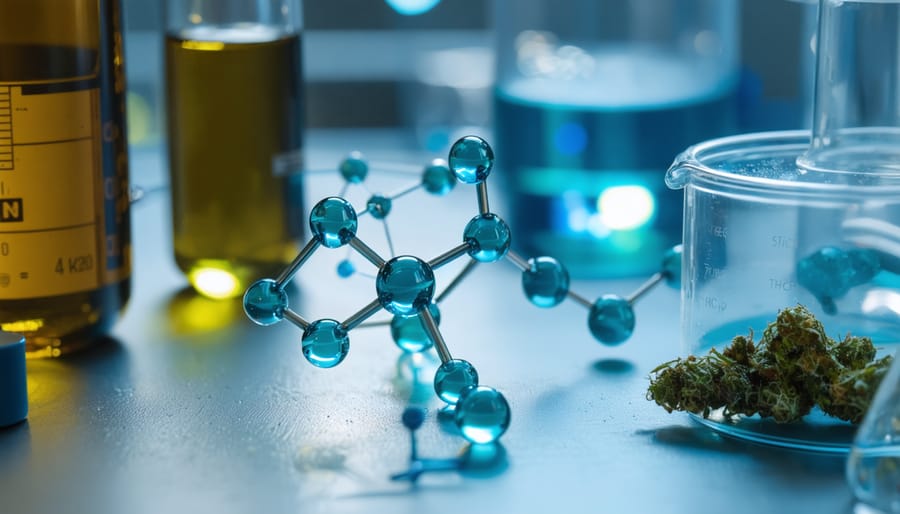
Budpop’s THCP represents a breakthrough in cannabinoid molecular biology research, challenging established paradigms about phytocannabinoid potency and receptor selectivity. Tetrahydrocannabiphorol (THCP), first isolated in 2019, exhibits a binding affinity for CB1 receptors 33-fold higher than Δ9-tetrahydrocannabinol (THC), fundamentally altering our understanding of cannabis pharmacology and demanding rigorous investigation into its biosynthetic pathways and molecular mechanisms.
Understanding THCP biosynthesis begins with analyzing the enzymatic modifications that extend the alkyl side chain from the typical pentyl configuration to a heptyl structure. This seven-carbon tail significantly enhances lipophilicity and receptor binding kinetics, creating unprecedented challenges and opportunities for pharmaceutical development. Researchers must map the prenyltransferase variants and polyketide synthase activities that catalyze this elongation, identifying genetic markers that predict THCP content in Cannabis sativa cultivars.
The molecular pharmacology of THCP extends beyond simple receptor occupancy. Its enhanced binding kinetics produce prolonged residence time at cannabinoid receptors, altering downstream signaling cascades including G-protein activation, cyclic AMP modulation, and MAPK pathway engagement. These pharmacodynamic properties necessitate revised dosing frameworks and safety protocols, particularly for therapeutic applications targeting chronic pain, appetite disorders, and neurodegenerative conditions.
For product developers and quality control professionals, characterizing THCP requires advanced analytical methods including high-resolution mass spectrometry and nuclear magnetic resonance spectroscopy. Establishing standardized extraction protocols, stability profiles, and bioavailability metrics remains essential for translating this potent cannabinoid from laboratory curiosity to viable commercial applications. This comprehensive examination addresses both fundamental molecular biology and practical implementation strategies critical for advancing THCP research and development.

The Molecular Blueprint: THCP Biosynthetic Pathways
Enzymatic Synthesis and Cannabinoid Precursors
The biosynthesis of tetrahydrocannabiphorol (THCP) follows a well-characterized enzymatic pathway shared by major cannabinoids, with critical modifications that distinguish its unique heptyl side chain. This process begins with two foundational precursors: olivetolic acid, derived from polyketide synthesis, and geranyl pyrophosphate (GPP), an isoprenoid intermediate from the mevalonate pathway.
The initial committed step involves an aromatic prenyltransferase enzyme that catalyzes the alkylation of olivetolic acid with GPP, forming cannabigerolic acid (CBGA)—often termed the “mother cannabinoid.” However, for THCP biosynthesis specifically, the pathway requires a homologous precursor: divarinic acid, which possesses a seven-carbon (heptyl) alkyl chain rather than the pentyl chain found in standard olivetolic acid. This structural variation originates earlier in polyketide biosynthesis, where hexanoyl-CoA serves as the starter molecule instead of the typical butyryl-CoA, resulting in the extended carbon chain that ultimately characterizes THCP.
Recent collaborative research from leading phytochemistry laboratories has identified that the same prenyltransferase enzyme exhibits substrate flexibility, accepting divarinic acid to produce cannabigerovarinic acid (CBGVA), the direct precursor to THCP-carboxylic acid. This enzymatic promiscuity provides crucial insights for biotechnological production strategies.
The subsequent cyclization step involves THCP synthase, an oxidocyclase enzyme that stereoselectively converts CBGVA into Δ9-tetrahydrocannabiphorolic acid (THCPA). This FAD-dependent enzyme catalyzes both oxidative and cyclization reactions, establishing the tricyclic structure characteristic of THC-type cannabinoids. The synthase demonstrates remarkable regioselectivity, closing the pyran ring to yield the pharmacologically active Δ9-isomer predominantly.
Industry experts note that the relatively low natural abundance of THCP in *Cannabis sativa* strains correlates with limited availability of the heptyl-chain precursor pool. Engineering enhanced production requires either metabolic pathway optimization to increase divarinic acid synthesis or heterologous expression systems in microbial hosts. Current biotechnological approaches focus on introducing biosynthetic gene clusters encoding both the polyketide synthase enzymes with modified chain-length specificity and the downstream oxidocyclases into yeast or bacterial chassis, offering scalable alternatives to plant extraction for pharmaceutical applications.
Understanding these enzymatic mechanisms proves essential for quality control professionals developing standardized THCP products and for researchers investigating structure-activity relationships underlying this cannabinoid’s enhanced receptor potency.
Genetic Determinants and Strain Variability
The production of tetrahydrocannabiphorol (THCP) in cannabis plants is governed by complex genetic architecture, with significant variability observed across different cultivars. Central to THCP biosynthesis are cannabinoid synthase genes, particularly THCP synthase variants that catalyze the conversion of cannabigerolic acid (CBGA) to tetrahydrocannabiphorolic acid (THCPA). Recent genomic analyses reveal that genetic polymorphisms in these synthase genes directly influence enzyme efficiency, substrate specificity, and ultimately, THCP accumulation in plant tissues.
Studies examining high-THCP-producing strains have identified single nucleotide polymorphisms (SNPs) in the active site regions of cannabinoid synthases that enhance the enzyme’s affinity for longer-chain fatty acid precursors. These genetic variations appear to modulate the enzyme’s catalytic pocket geometry, favoring heptyl side-chain incorporation over pentyl chains. Industry experts note that strains originating from specific geographical regions, particularly certain Italian landraces, demonstrate consistently elevated THCP levels, suggesting selective pressure or founder effects may have enriched these genetic variants.
Gene expression profiling indicates that THCP production is not solely dependent on synthase gene sequence but also on regulatory elements controlling transcription. Promoter region variations and epigenetic modifications significantly impact mRNA levels of biosynthetic enzymes. Environmental factors such as light spectrum, temperature stress, and nutrient availability can trigger differential gene expression, explaining why genetically identical clones may exhibit THCP variability under different cultivation conditions.
For breeding programs, marker-assisted selection using SNP arrays targeting synthase genes enables rapid identification of high-THCP genotypes without waiting for plant maturity and chemical analysis. This accelerates cultivar development substantially. Meanwhile, biotechnology applications leverage genetic modification techniques including CRISPR-Cas9 gene editing to enhance THCP biosynthesis in heterologous systems such as yeast or bacterial hosts. These microbial platforms offer controlled production environments for pharmaceutical-grade THCP synthesis.
Understanding the genetic determinants of THCP production also has implications for intellectual property considerations and regulatory compliance. As biopharmaceutical companies develop THCP-based therapeutics, characterizing the genetic basis of production becomes essential for establishing reproducible manufacturing processes and ensuring batch-to-batch consistency in clinical applications. Future research integrating metabolomics with genomics will likely unveil additional regulatory genes and metabolic bottlenecks that can be targeted to optimize THCP yields.

Molecular Pharmacology: How THCP Interacts With the Endocannabinoid System
CB1 and CB2 Receptor Binding Affinity
Δ⁹-tetrahydrocannabiphorol (THCP) demonstrates remarkable binding affinity to both CB1 and CB2 cannabinoid receptors, substantially exceeding that of its more common analog, Δ⁹-tetrahydrocannabinol (THC). This enhanced potency stems primarily from THCP’s distinctive seven-carbon alkyl side chain, compared to THC’s five-carbon configuration—a structural variation that profoundly impacts receptor binding dynamics.
Quantitative binding studies reveal THCP’s Ki value for CB1 receptors at approximately 1.2 nM, representing a 33-fold increase in binding affinity relative to THC’s 40 nM. For CB2 receptors, THCP exhibits a Ki value near 5.8 nM, demonstrating approximately ten-fold greater affinity than THC. These enhanced binding characteristics translate to significantly increased pharmacological activity, with in vivo studies suggesting THCP possesses activity levels exceeding THC by factors ranging from 5 to 30 in various cannabinoid-mediated responses.
The molecular basis for THCP’s superior binding lies in its extended alkyl chain, which facilitates deeper penetration into the hydrophobic binding pocket of cannabinoid receptors. Molecular modeling studies indicate that the seven-carbon chain achieves optimal van der Waals interactions with hydrophobic residues lining the receptor cavity, stabilizing the ligand-receptor complex more effectively than shorter chains. This extended configuration promotes conformational changes in the receptor’s transmembrane helices, particularly affecting helices III, V, and VI, which are critical for G-protein coupling and downstream signal transduction.
Crystallographic and computational analyses reveal that THCP induces a more pronounced outward displacement of transmembrane helix VI compared to THC, a conformational shift associated with enhanced receptor activation. The additional two carbon atoms provide optimal spatial fit within the binding pocket, maximizing hydrophobic contacts while maintaining proper orientation of the phenolic hydroxyl group—essential for hydrogen bonding with key amino acid residues such as serine and lysine within the binding site.
Understanding these cannabinoid receptor mechanisms proves crucial for researchers developing novel cannabinoid therapeutics, as side chain length emerges as a critical determinant of receptor affinity and pharmacological activity. Industry experts note that this structure-activity relationship provides valuable insights for rational drug design, enabling targeted modifications to optimize therapeutic profiles while potentially minimizing unwanted effects through selective receptor targeting.
Signal Transduction and Downstream Effects
Following THCP binding to CB1 and CB2 cannabinoid receptors, a sophisticated cascade of intracellular events orchestrates the compound’s physiological effects. As G-protein coupled receptors (GPCRs), cannabinoid receptors initiate signal transduction through heterotrimeric G-proteins, primarily of the Gi/o family. Upon THCP-receptor complex formation, the Gα subunit exchanges GDP for GTP, triggering dissociation of Gα from Gβγ subunits—each capable of modulating distinct downstream targets.
The Gα(i/o) component inhibits adenylyl cyclase activity, reducing cyclic AMP (cAMP) production and consequently diminishing protein kinase A (PKA) activity. This modulation of molecular pathways affects gene transcription through cAMP response element-binding protein (CREB) phosphorylation states. Simultaneously, liberated Gβγ dimers activate G-protein-coupled inwardly rectifying potassium (GIRK) channels, inducing membrane hyperpolarization that reduces neuronal excitability—a mechanism underlying THCP’s analgesic and sedative properties.
THCP also modulates voltage-gated calcium channels, particularly N-type and P/Q-type channels in presynaptic terminals, inhibiting calcium influx and subsequent neurotransmitter release. This presynaptic inhibition represents a critical mechanism for cannabinoid-mediated modulation of synaptic transmission across various neural circuits.
Beyond classical GPCR signaling, THCP activates mitogen-activated protein kinase (MAPK) cascades, including extracellular signal-regulated kinases (ERK1/2), p38 MAPK, and c-Jun N-terminal kinases (JNK). These pathways regulate cellular proliferation, differentiation, and apoptosis, contributing to both therapeutic effects and potential toxicological concerns. Recent evidence suggests THCP may also engage β-arrestin-mediated signaling, independent of G-protein activation, representing biased agonism that could explain divergent pharmacological profiles compared to THC.
At the cellular level, these convergent signals produce measurable responses including altered gene expression, changes in neurotransmitter release patterns, modulation of inflammatory mediator production, and shifts in cellular metabolism. Understanding these intricate signaling networks proves essential for predicting THCP’s therapeutic potential and optimizing formulations for specific clinical applications.
Pharmacokinetics and Bioavailability
THCP exhibits distinct pharmacokinetic properties that significantly influence its therapeutic potential and product formulation strategies. Due to its seven-carbon alkyl side chain, THCP demonstrates enhanced lipophilicity compared to Δ⁹-THC, facilitating rapid tissue distribution and efficient blood-brain barrier penetration. This increased lipid solubility impacts bioavailability and absorption profiles, with oral administration typically yielding 6-20% bioavailability due to extensive first-pass hepatic metabolism, while inhalation routes demonstrate 10-35% bioavailability with faster onset kinetics.
Metabolically, THCP undergoes Phase I oxidation primarily via hepatic cytochrome P450 enzymes (CYP2C9, CYP3A4), producing hydroxylated metabolites including 11-hydroxy-THCP, followed by Phase II glucuronidation. The extended alkyl chain may alter metabolic susceptibility compared to traditional cannabinoids, potentially affecting elimination half-life estimates of 24-48 hours. THCP’s high lipophilicity promotes accumulation in adipose tissue, creating a reservoir effect with prolonged elimination.
For product developers, these ADME characteristics necessitate careful consideration of delivery systems—nanoemulsions and liposomal formulations may enhance oral bioavailability, while controlled-release mechanisms can manage extended tissue residence. Understanding individual variability in CYP450 expression remains critical for optimizing dosing regimens in commercial applications.
From Lab to Market: THCP Product Development Considerations
Extraction and Purification Technologies
The isolation and production of tetrahydrocannabiphorol (THCP) presents unique challenges due to its trace concentrations in cannabis plant material, typically representing less than 0.1% of total cannabinoid content. Current extraction methodologies must balance efficiency with preservation of molecular integrity.
**Plant-Based Extraction Approaches**
Traditional extraction from cannabis biomass employs supercritical CO₂ or ethanol-based methods, yielding crude extracts requiring extensive purification. High-performance liquid chromatography (HPLC) coupled with preparative-scale columns enables THCP isolation, though the compound’s structural similarity to tetrahydrocannabinol (THC) necessitates optimized mobile phase compositions and extended separation times. Recent advances in centrifugal partition chromatography (CPC) offer improved scalability by exploiting differential solubility between immiscible liquid phases, achieving purities exceeding 95% while maintaining faster throughput than conventional silica-based methods.
Industry experts emphasize that flash chromatography with specialized cannabinoid-grade silica remains cost-effective for research-scale purification, while preparative supercritical fluid chromatography (pSFC) represents the emerging standard for commercial-scale operations, offering superior resolution with reduced solvent consumption.
**Biotechnological Production Systems**
Heterologous biosynthesis in engineered microorganisms provides a sustainable alternative to plant extraction. Researchers have successfully reconstituted cannabinoid biosynthetic pathways in *Saccharomyces cerevisiae* and *Escherichia coli* by introducing genes encoding polyketide synthase, olivetolic acid cyclase, and specific prenyltransferases. The production of THCP specifically requires engineering organisms to incorporate heptyl-CoA precursors instead of the typical pentyl-CoA, achieved through metabolic pathway optimization and cofactor balancing.
Current yields from microbial systems remain modest, typically ranging from 50-150 mg/L in optimized fermentation conditions. However, cutting-edge research demonstrates that CRISPR-mediated genome editing combined with directed evolution of biosynthetic enzymes significantly enhances production titers. These bioengineered approaches offer advantages including reproducible cannabinoid profiles, elimination of regulatory complexities associated with cannabis cultivation, and potential for continuous manufacturing processes—critical considerations for pharmaceutical-grade THCP production.

Dosing Precision and Safety Profiles
The exceptional potency of tetrahydrocannabiphorol (THCP) at CB1 receptors—demonstrating binding affinity approximately 33-fold higher than Δ9-THC—necessitates rigorous dosing precision and comprehensive safety considerations. Molecular pharmacology data reveals that THCP’s enhanced receptor occupancy translates to pronounced physiological effects at substantially lower concentrations, fundamentally altering the therapeutic window compared to conventional cannabinoids.
Current pharmacological evidence suggests that effective THCP doses may range from 0.5 to 3 milligrams for psychoactive effects, compared to 5-15 milligrams typical for Δ9-THC. This narrow dosing range demands exceptional manufacturing standardization and precise quantification methods. High-performance liquid chromatography coupled with mass spectrometry (HPLC-MS) serves as the gold standard for THCP quantification, with detection limits reaching sub-nanogram sensitivity to ensure accurate product labeling.
The therapeutic window—the margin between efficacious and adverse effect doses—appears considerably narrower for THCP based on receptor binding kinetics. Industry experts emphasize that this compressed therapeutic index requires conservative initial dosing protocols, typically starting at 0.1-0.5 milligrams with gradual titration under controlled conditions. The prolonged receptor residence time observed in radioligand displacement studies suggests extended duration of action, potentially 6-8 hours or longer, complicating dose adjustment strategies.
Potential adverse effects extrapolated from molecular pharmacology data include intensified CB1-mediated responses: heightened anxiety, tachycardia, hypotension, and cognitive impairment at supra-therapeutic doses. The lack of extensive human clinical trials necessitates conservative risk assessment based on receptor activity profiles and preclinical models. Recent collaborative research from pharmaceutical development teams indicates that individual genetic polymorphisms in CB1 receptor expression (CNR1 gene variants) may significantly influence THCP sensitivity, suggesting future personalized dosing approaches.
Product standardization emerges as paramount given THCP’s potency variability in plant extracts, typically constituting 0.01-0.1% of total cannabinoid content. Batch-to-batch consistency requires validated analytical methods with coefficients of variation below 5%. Quality control laboratories must implement stringent protocols including certificate of analysis documentation, stability testing under various storage conditions, and verification of absence of degradation products. Biopharmaceutical companies developing THCP-based therapeutics should establish clear dosing guidelines supported by pharmacokinetic modeling, emphasizing the critical relationship between molecular receptor interactions and clinical safety parameters.
Analytical Challenges and Quality Assurance
Detection Methods and Analytical Standards
Accurate detection and quantification of tetrahydrocannabiphorol (THCP) requires sophisticated analytical approaches that can differentiate this rare cannabinoid from its structural analogs, particularly Δ9-tetrahydrocannabinol (THC). High-performance liquid chromatography (HPLC) coupled with ultraviolet detection represents the foundational technique, though the structural similarities between THCP and THC—differing only in their alkyl side chain length—demand optimized chromatographic conditions to achieve baseline separation.
Mass spectrometry (MS) provides the most definitive identification of THCP. Liquid chromatography-tandem mass spectrometry (LC-MS/MS) has emerged as the gold standard, enabling detection at nanogram-per-gram concentrations through characteristic fragmentation patterns. THCP exhibits a molecular ion [M+H]+ at m/z 315.2, compared to THC’s m/z 315.2, making accurate mass determination critical. High-resolution mass spectrometry (HRMS) instruments, such as quadrupole time-of-flight (Q-TOF) systems, offer the mass accuracy necessary to distinguish these compounds based on subtle differences in their product ion spectra.
Gas chromatography-mass spectrometry (GC-MS), while traditional for cannabinoid analysis, presents challenges due to thermal decarboxylation and the limited availability of THCP reference materials. The scarcity of certified reference standards remains a significant obstacle for laboratories establishing validated analytical methods. Currently, only a handful of specialized suppliers provide authenticated THCP standards, often at premium costs, complicating quality control efforts in commercial applications.
Industry experts emphasize the importance of multi-dimensional analytical approaches. Two-dimensional LC (2D-LC) systems and ion mobility spectrometry coupled with MS provide additional separation dimensions, proving particularly valuable in complex cannabis matrices where co-eluting compounds may interfere. As THCP-containing products enter regulated markets, the development of standardized analytical protocols and increased availability of reference materials will be essential for ensuring product quality and consumer safety.

Stability and Degradation Pathways
THCP’s extended alkyl side chain renders it more lipophilic than THC, significantly influencing its stability profile and degradation kinetics. The seven-carbon tail increases susceptibility to oxidative degradation, particularly at the terminal methyl groups, where free radical-mediated reactions can initiate chain breakdown. Under ambient conditions, THCP demonstrates moderate stability in darkness, but exhibits accelerated degradation upon exposure to UV light, oxygen, and elevated temperatures—factors that promote cannabinoid oxidation and isomerization.
Primary degradation pathways include photo-oxidation yielding hydroxylated derivatives, thermal decarboxylation at elevated temperatures, and acid-catalyzed cyclization reactions. Studies indicate that THCP stored in ethanol solutions at -20°C maintains >95% purity for six months, while room temperature storage in air-exposed containers results in approximately 15-20% degradation within 30 days. The biosynthetic origin from olivetolic acid precursors provides inherent phenolic antioxidant properties, though these are insufficient to prevent long-term degradation without proper formulation strategies.
Pharmaceutical formulations require light-resistant containers, inert atmosphere packaging (nitrogen or argon), and refrigerated storage to maintain molecular integrity. Industry experts recommend incorporating antioxidants such as butylated hydroxytoluene (BHT) or ascorbic acid derivatives in commercial preparations. Quality control protocols must account for major degradation products including THCP-quinone and various hydroxylated metabolites when assessing product stability and shelf-life parameters for biopharmaceutical applications.
The convergence of THCP biosynthesis research and molecular pharmacology represents a critical frontier in cannabinoid science, with profound implications for therapeutic development and product innovation. Understanding the enzymatic mechanisms that govern THCP production—from prenyltransferase activity through oxidocyclase-mediated ring closure—enables precise control over cannabinoid profiles in both plant-based and biosynthetic production systems. This molecular-level knowledge directly translates to manufacturing consistency, allowing developers to optimize extraction protocols and establish reliable quality control parameters essential for pharmaceutical-grade products.
The characterization of THCP’s enhanced CB1 receptor affinity and prolonged residence time at cannabinoid binding sites underscores the necessity of rigorous pharmacological profiling. Industry experts emphasize that even minor variations in molecular structure can dramatically alter therapeutic windows and safety profiles. As research continues to elucidate structure-activity relationships, biopharmaceutical companies gain the tools needed to design THCP derivatives with improved selectivity and reduced adverse effects.
Future research directions must prioritize metabolic pathway mapping, cannabinoid receptor subtype selectivity, and long-term pharmacokinetic studies. Collaborative efforts between academic institutions and commercial entities will accelerate translation from bench to bedside. The integration of cutting-edge analytical techniques—including cryo-electron microscopy of receptor-ligand complexes and metabolomics—promises to refine our understanding further. Ultimately, molecular-level insights into THCP biosynthesis and pharmacology form the indispensable foundation for developing safe, effective, and standardized cannabinoid therapeutics that meet stringent regulatory requirements while addressing unmet medical needs.


