
CRISPR gene editing is a method for making precise, targeted changes to DNA in plants, animals, and microorganisms. In the best-known version, CRISPR/Cas9, a guide RNA directs the Cas9 enzyme to a specific genetic sequence, where it cuts the DNA. The cell then repairs the break using its own natural repair processes, and researchers harness that repair to disable a gene, correct a mutation, or introduce a new sequence.
That cut-and-repair logic is why CRISPR has reshaped molecular biology. It is faster and more adaptable than earlier tools such as zinc finger nucleases (ZFNs) and transcription activator-like effector nucleases (TALENs), which also cut DNA at chosen sites but require custom protein engineering for each target. The scale of current activity reflects this shift: the CMN Clinical Trials Q2 2026 Global Report tracks 306 publicly disclosed gene-editing clinical trials, with the United States and China leading by trial count.
Oversight matters as much as the science. In Canada, plants, animal feed, and human food fall under different laws, and editing human genes is restricted. This article explains how the mechanism works, compares the main editing techniques and their components, and outlines where the technology is applied today.
What CRISPR Gene Editing Means: A Plain-Language Definition

CRISPR-Cas genome editing is a method for making specific, targeted changes to the DNA of plants, animals, or microorganisms. “Targeted” is the operative word. Rather than inserting genetic material at random and hoping it lands somewhere useful, researchers aim the system at one chosen sequence in the genome and alter only that spot.
Precision matters because a genome is enormous, and a change in the wrong place can disrupt a gene that was working perfectly well. A tool that can find a single sequence among billions of letters, and leave the rest alone, is far more useful than one that edits blindly. That specificity is why CRISPR has become so central to molecular biology, from basic research to crop improvement to clinical development.
At its core, the mechanism is a two-part process. CRISPR/Cas9 edits genes by precisely cutting DNA and then harnessing natural DNA repair processes to modify the gene in the desired manner.
A common reader question is how a genome-edited organism differs from a genetically modified one. In broad terms, genome editing alters the organism’s own DNA at a chosen location, while genetic modification is often associated with introducing genetic material from elsewhere. Regulators draw their own lines here, and those definitions vary, so it is worth checking the rules that apply to a specific product rather than assuming the two terms are interchangeable.
The system itself was not invented from scratch. It borrows from bacteria, which use it as a form of CRISPR adaptive immune defense against invading viruses. Researchers adapted that natural machinery into a programmable editing tool.
How CRISPR Works: From Targeting to Cut to Repair

Finding the Target: Guide RNA and DNA Recognition
The first job in any edit is finding the right spot in a genome that can contain billions of base pairs. CRISPR handles this with a guide RNA, a short RNA molecule that acts like a built-in address label. The guide RNA pairs with the Cas protein, and together they scan the DNA until the guide finds a sequence it can match base by base.
Recognition rests on complementarity. DNA’s four bases bind in predictable pairs, so a guide RNA carrying a sequence of roughly twenty nucleotides will bind to the stretch of DNA that complements it. When the match is good, the Cas protein is held in place at that site, ready for the next step. When the match fails, the complex moves on. In the widely used Cas9 system, the protein also needs to detect a short neighboring sequence known as a PAM (protospacer adjacent motif) before it will engage the DNA, which adds a second layer of checking.
This is what makes the system so adaptable. The Cas protein stays the same, while the guide sequence can be rewritten to point at a different gene. Redirecting the tool means changing a short stretch of RNA rather than engineering a new protein from scratch. That programmability helps explain why CRISPR-Cas has been applied to the DNA of plants, animals, and microorganisms alike.
Cutting the DNA: The Role of Cas9
Once the guide RNA has matched its complementary DNA sequence, the Cas9 protein does the physical work. Cas9 is a nuclease, meaning an enzyme that cleaves nucleic acids, and in this system it acts as the molecular scissors. Its job is to cut the DNA at the targeted site rather than anywhere else in the genome.
The cut is what makes editing possible. Intact, double-stranded DNA is stable and tightly packaged, so the cell has no obvious way to change a gene’s sequence on its own. By severing both strands at a chosen location, Cas9 creates a break that the cell treats as damage. That break is the opening: it exposes the gene to the cell’s repair machinery, which is where the actual modification takes place.
Precision matters here. Because the guide RNA positions Cas9 at a specific sequence, the cut lands where the researcher intended, which is what separates CRISPR from older, less directed approaches to changing DNA. The enzyme itself does not decide what the new sequence will be. It only provides the cut.
That distinction is easy to miss. A cut alone does not produce an edit; it simply sets the stage. What happens next depends entirely on how the cell chooses to repair the break.
Repair and Outcome: Harnessing the Cell’s Own Machinery
Cutting the DNA is only half the job. Once Cas9 makes its break, the cell takes over, and the repair route it chooses largely decides what the final edit looks like. CRISPR supplies the cut; the cell’s own machinery writes the result.
Two natural pathways matter most. In non-homologous end joining (NHEJ), the cell simply stitches the broken ends back together. Because NHEJ is error-prone the repair can add or delete a few DNA letters at the junction. Those small insertions or deletions often disrupt a gene’s reading frame, which is why this route is commonly used to switch a gene off.
The second pathway, homology-directed repair (HDR), uses a matching DNA template as a guide. If researchers supply a template carrying a desired sequence, the cell can copy it into the break site, producing a more precise change such as correcting a single mutation or inserting new sequence.
This is why the same cut can yield different outcomes. Which pathway dominates depends on the cell and its conditions, not on Cas9 alone. For anyone evaluating a CRISPR experiment, the useful question is not just “where did it cut?” but “how did the cell repair it?” Understanding repair behavior is central to predicting, and controlling, the edit you actually get.
The Molecular Components Behind the Mechanism
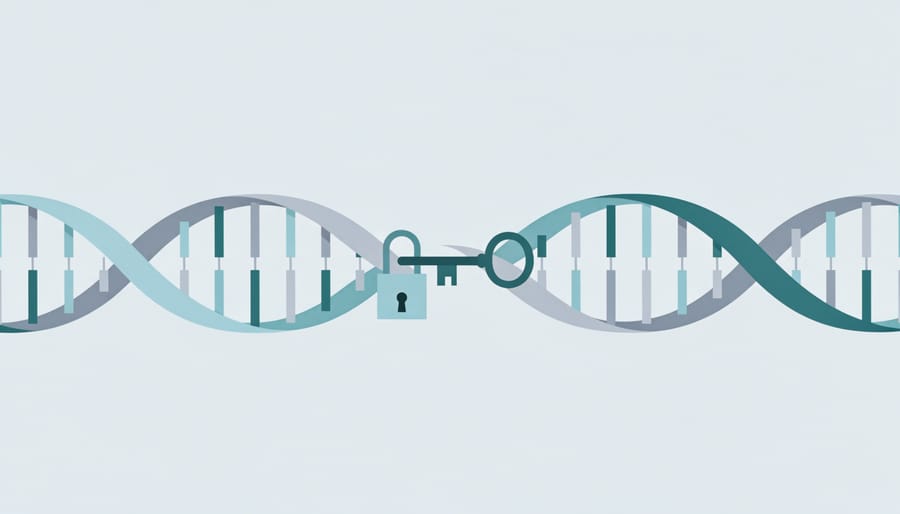
Every CRISPR-Cas edit depends on a small set of molecular players. Each has a distinct job, and the edit only works when all of them act in sequence. The glossary below sets out the core terms, which map directly onto the targeting, cutting, and repair stages described above.
- CRISPR
- Short for clustered regularly interspaced short palindromic repeats, the name of the bacterial genetic system that scientists adapted for genome editing. In practice, “CRISPR” also names the editing toolkit built from it.
- Cas9 nuclease
- The protein that acts as molecular scissors. It cuts both strands of DNA at the site the guide RNA points it to, opening the genome for editing.
- Guide RNA
- A short RNA molecule that carries the targeting information. It pairs with a matching DNA sequence and leads the Cas protein to the right place.
- Target DNA sequence
- The specific stretch of the genome that researchers want to change. The guide RNA is designed to be complementary to it, which is why the system can be reprogrammed for different genes.
- DNA repair pathway
- The cell’s own machinery for fixing a broken DNA strand. The pathway the cell uses determines what the final edit looks like.
Seen together, these components divide the labor neatly. The guide RNA supplies specificity, the Cas9 nuclease supplies the cutting action, and the target sequence defines where the change happens. The cell’s repair pathway then finishes the job. That last point matters most for students and practitioners alike: the cut is not the edit. Because the outcome depends on how the cell repairs the break, researchers treat repair behavior as a design consideration, not an afterthought.
This modular structure also explains why CRISPR-Cas is so adaptable. Swapping the guide RNA redirects the same Cas protein to a new location, so one core system can serve many different editing goals across plants, animals, and microorganisms.
CRISPR-Cas, TALENs, and ZFNs: How the Common Genome Editing Techniques Differ
CRISPR-Cas is one of several genome editing techniques. The three most commonly cited are CRISPR-Cas, TALENs (transcription activator-like effector nucleases), and ZFNs (zinc finger nucleases). All three work by creating a targeted break in DNA, then relying on the cell’s own repair processes to produce the edit. What separates them is how each one finds its target sequence.
- CRISPR-Cas: a guide RNA, paired with a Cas protein, recognizes a complementary DNA sequence and directs the cut.
- TALENs: a custom-built DNA-binding protein recognizes the target sequence and is fused to a nuclease that makes the cut.
- ZFNs: engineered zinc finger proteins bind the target DNA and are fused to a nuclease that makes the cut.
The conceptual difference is where the targeting information lives. In TALENs and ZFNs, recognition is built into the protein itself, so aiming at a new sequence means engineering a new protein. In CRISPR-Cas, recognition is carried by a short RNA molecule, so retargeting mainly means changing the guide sequence while the Cas protein stays the same. This RNA-based programmability is a large part of why CRISPR-Cas has become so widely discussed.
That said, “different” does not automatically mean “better for every job.” Specificity, ease of design, the target organism and the intended application all factor into tool selection, and published comparisons vary by context. We won’t rank the three here, since any ranking would depend on the specific experiment and the evidence behind it.
For readers weighing these options, commentary from molecular biology researchers who work with all three systems is the most reliable guide to choosing among them. Their practical experience with design effort, validation and fit for a given project fills in what a conceptual comparison cannot.
How CRISPR Is Used: Research, Agriculture, and Clinical Development
CRISPR-Cas editing has moved well beyond the research bench, though its uses fall into a few distinct areas.
In basic research, scientists use the system to switch off or alter a single gene in cell lines, plants, animals, or microorganisms and then observe what changes. That cause-and-effect approach has made it a routine tool for studying gene function, and because the targeting is programmable, a lab can redirect the same machinery to a new gene without rebuilding the system from scratch.
In agriculture, the same cut-and-repair logic is applied to plant and animal genomes to introduce specific, targeted changes. Breeders can work on traits within a plant’s own genome, which is one reason genome-edited products are discussed differently from some earlier genetically engineered crops. Research into tastier vegetables shows the kind of everyday trait improvement this precision makes possible. Microorganisms are edited as well, since their small genomes make them convenient subjects for both research and engineering.
The clinical side is where attention has grown fastest. Clinical gene editing applies the technique to human cells with a therapeutic goal, and the pipeline is now large enough to measure. The CMN Clinical Trials Q2 2026 Global Report covers 306 publicly disclosed gene-editing clinical trials, curated as of 31 July 2026. By trial count, the United States and China lead, followed by the United Kingdom, Australia, Canada, and several European countries. That distribution shows the work is international, with activity concentrated in a handful of research-intensive countries.
It is worth being precise about what that figure tells us. It counts publicly disclosed trials, so it describes the breadth of clinical activity rather than how any individual therapy is performing. For a deeper look at how CRISPR in humans is being developed and what is happening this year, that companion article is a good next step.
Whatever the application, the underlying logic is the same one described earlier: a targeted cut, followed by the cell’s own repair machinery producing the final edit.
Regulation and Oversight: What the Mechanism Means for Policy
Because CRISPR-Cas editing works by cutting DNA and letting the cell’s own repair machinery finish the change, the technology sits squarely in the sights of regulators. A tool that can alter the genetic makeup of plants, animals, or microorganisms raises a basic policy question: how should the resulting products be assessed, and by whom?
Canada offers a useful illustration. The Government of Canada regulates plants, animal feed, and human food under different laws, so the same underlying editing technique can fall under different oversight depending on what is being produced and how it reaches consumers. Editing human genes is a separate matter, and it is restricted in Canada. The distinction matters because a change to a crop or a feed ingredient is a different kind of intervention from a change to a person’s genome, and policy tends to reflect that gap.
The broader challenge is that regulation has to keep pace with a fast-moving field. The clinical side shows the scale of activity: the CMN Clinical Trials Q2 2026 Global Report covers 306 publicly disclosed gene-editing clinical trials, curated as of 31 July 2026. With that many programs underway across multiple countries, oversight frameworks are likely to remain a subject of active attention.
Readers should also note that rules vary between jurisdictions, and this article does not attempt to catalogue them. Meanwhile, advances in AI in molecular biology are reshaping how researchers design and evaluate edits, which may in turn influence how regulators think about risk and review. For anyone working with or following these products, checking the specific laws that apply to a given product category remains the sensible starting point.
CRISPR Gene Editing FAQs
What are genome editing techniques?
Genome editing techniques are methods for making specific, targeted changes to the DNA of plants, animals, or microorganisms. The most common are CRISPR-Cas, TALENs, and ZFNs, which differ mainly in how they locate the DNA sequence to be altered.
How does CRISPR/Cas9 actually change a gene?
It uses a guide RNA to direct the Cas9 protein to a matching DNA sequence, where it makes a precise cut. The cell’s own repair processes then modify the gene, and the repair pathway taken shapes the final edit.
Who regulates biotechnology products in Canada?
The Government of Canada regulates plants, animal feed, and human food under different laws, so oversight depends on the type of product. Editing human genes is restricted in Canada.
Where is clinical gene editing happening?
The CMN Clinical Trials Q2 2026 Global Report covers 306 publicly disclosed gene-editing clinical trials, curated as of 31 July 2026. The United States and China lead by trial count, followed by the United Kingdom, Australia, Canada, and several European countries.
Readers also ask how genome-edited organisms differ from genetically modified ones. The short answer is that editing makes targeted changes to an organism’s existing DNA, and the definition section above covers that distinction in more detail. How a given product is classified, though, is a regulatory question, which is why the rules above vary by product type.
Questions about how DNA changes spread through populations and shape our collective genetic landscape are a separate topic from the editing mechanism itself. The mechanism describes what happens at one targeted site in one cell. Broader questions about populations depend on factors this article does not address.
At its core, the CRISPR gene editing mechanism is a two-stage process: a guide RNA steers the Cas9 nuclease to a matching DNA sequence, where it makes a precise cut, and the cell’s own repair machinery then reshapes the gene. That second stage is what determines the final edit, which is why the repair pathway matters as much as the cut itself.
Compared with TALENs and ZFNs, the other common genome editing techniques, CRISPR-Cas stands apart in how targeting works. It relies on a programmable RNA guide rather than a custom-engineered protein for each site. The technology is now used across plants, animals, and microorganisms, and it is moving through clinical development, with 306 publicly disclosed gene-editing trials curated as of 31 July 2026.
Oversight is evolving alongside the science. In Canada, plants, animal feed, and human food fall under different laws, and editing human genes is restricted. Anyone following this field should keep watching clinical trial reports and regulatory updates, since both will shape where the technology goes next.